

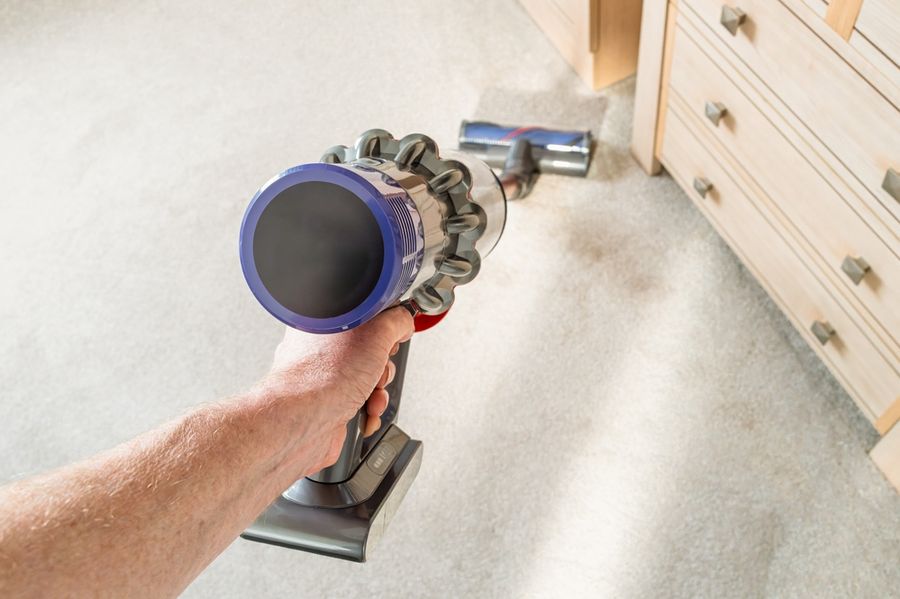
Cordless vacuums are popular because they are quick to grab, easy to store, and great for daily messes. Still, the best cordless vacuum for an apartment is often different from the best choice for a house. Apartments usually need compact storage, easy steering, and low hassle. Houses often need longer battery life, larger dirt bins, and stronger cleaning for mixed floors. It's important to compare what matters most to find the best model for your needs.
What Apartment Cleaning Needs Most
Apartments tend to have tighter spaces, more furniture close together, and less storage. That makes weight, turning ability, and where the vacuum lives (closet, corner, wall mount) feel more important than raw power.
A good apartment pick usually has:
- A slimmer head that fits under beds and couches
- Simple emptying for small, frequent cleanups
- Good hard-floor performance (common in many apartments)
- Attachments for couches, corners, and baseboards
Dyson’s V15 Detect is an example of a premium cordless model that focuses on ease of everyday cleaning with features like surface detection and automatic suction adjustment, plus a soft roller style head designed for hard floors. That kind of automatic adjustment can be useful in apartments where you move between rugs, mats, and hard floors in short bursts.
If you have a small space and clean in short sessions, you may not need the biggest bin or the longest runtime. You do want a vacuum that is easy to maneuver without bumping every chair leg.
What House Cleaning Needs Most
Houses often mean more square footage, more rooms, and more floor changes. The “daily use” question becomes: can you clean a full level without stopping to charge, and can the vacuum handle carpet, hard floors, and pet hair without constant maintenance?
A strong house-focused cordless vacuum often needs:
- Longer total runtime or swappable batteries
- Better carpet cleaning, not just hard-floor pickup
- A larger bin or an approach that reduces emptying
- Stronger edge cleaning and pet hair handling
LG’s CordZero A9 Kompressor line is an example where the product design focuses on longer cleaning sessions through dual batteries, which can help in larger homes where one charge may not cover everything. Samsung’s Jet 90 line also highlights a removable battery concept, which can matter when you want an extra battery ready for larger cleaning days.
For houses, the most important “spec” is not a single number. It is whether the vacuum fits your cleaning pattern: quick daily passes plus a longer weekly clean.
Battery Life and Charging
Battery needs are usually the biggest difference between apartments and houses. Apartment users often do short cleans and can recharge easily. House users often want fewer interruptions and more flexibility.
Two patterns work well for houses:
- A vacuum with a removable battery, so you can swap instead of waiting.
- A vacuum that ships with two batteries, so you can rotate power for bigger jobs.
LG’s CordZero A9 Kompressor is commonly positioned around the idea of longer runtime through dual batteries. If you live in a smaller apartment, you may be fine with one battery as long as charging is simple and the vacuum is easy to dock.
Also consider where the charger goes. If your space is small, a wall mount may be perfect. If you have multiple floors, a vacuum that is easy to carry and quick to charge becomes more valuable.
Floor Types and Heads
Apartments often have more hard floors and low-pile rugs. Houses often have more carpet, stairs, and mixed surfaces. The right floor head can matter as much as the vacuum body.
Dyson’s V15 Detect is reviewed as having a surface detection system that adjusts suction based on floor type, plus heads designed for both hard floors and carpets. That kind of setup is helpful if you have a mix of floors in either an apartment or a house, but it tends to matter more in a house where you may switch surfaces many times in one session.
If you have pets, look for designs aimed at hair pickup and reduced hair wrap. Shark’s Stratos Cordless lineup highlights Clean Sense IQ, which detects dirt and boosts power automatically, and it also emphasizes hair pickup with its floor nozzle design. For many households, pet hair is the difference between “good enough” and “daily frustration,” so it is worth matching the vacuum head to your real mess.
Dirt Bin Size and Emptying
Apartment cleaning usually creates smaller loads. Emptying a bin every day or two is not a big deal. Houses can fill bins quickly, especially with pets, kids, or heavy carpet use.
If you hate frequent emptying, look for features that stretch time between dumps. LG promotes its “Kompressor” approach as a way to compress debris in the bin so you can keep cleaning longer before emptying. That can be more useful in a house where you want to finish a level in one pass.
For apartments, a smaller bin can be fine if the vacuum is easy to open, easy to dump, and does not puff dust everywhere when you empty it.
Match the Vacuum to Your Space
A cordless vacuum that feels perfect in an apartment can feel limiting in a house, and a house-focused model can feel bulky in a small space. For apartments, prioritize easy storage, light steering, and strong hard-floor pickup. For houses, prioritize runtime, carpet ability, and a plan for bin emptying and batteries.
Models like Dyson’s V15 Detect focus on smart adjustments and multi-surface heads, Shark’s Stratos Cordless emphasizes auto-boost cleaning, and options like LG CordZero and Samsung Jet put more attention on battery flexibility.